Welfare politics explainer
Benefit Cuts and Moral Theatre
A cut to benefits does not produce one clean moral result. It removes money from a defined group, then sorts people through work, housing, family support, debt and public services; politics often turns that messy distribution into a neater story about virtue, discipline and deservingness.
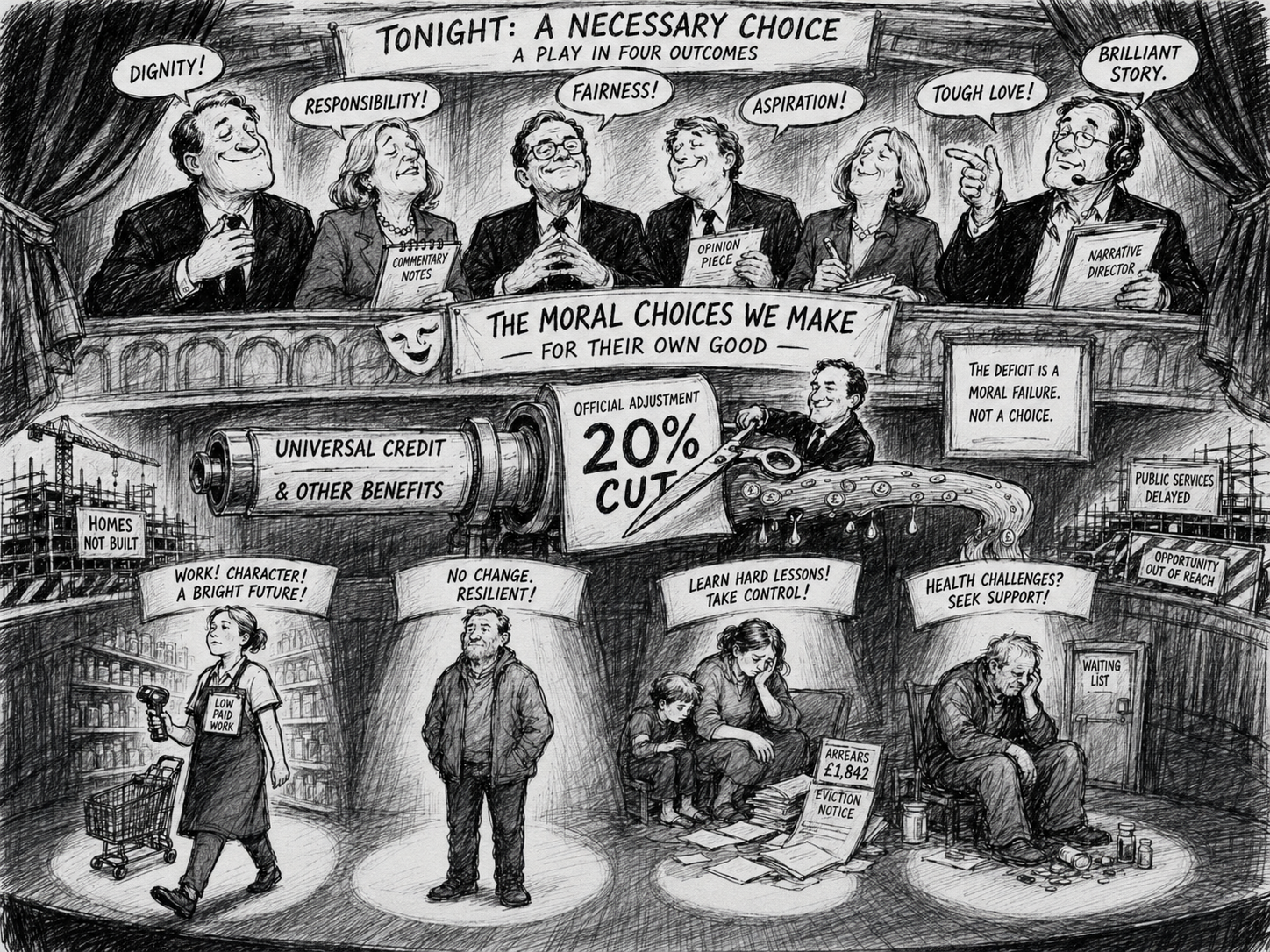
A 20 per cent cut in benefit spending is often discussed as though it were a clean moral experiment. Take money away, and one of two things is supposed to happen. Either hardship rises, proving the cruelty of the policy, or people move into work, proving the reformers right. The attraction of this framing is obvious. It gives politics a contest of virtues: compassion on one side, responsibility on the other.
Real life is less obliging. The first-order effect of such a cut is predictable: a defined group of people has less money than before. After that, the story fragments. Some households will barely move in any visible way, because the loss is absorbed by relatives, savings, informal work, cheaper food, colder homes, or debt that has not yet become a crisis. Some will be damaged badly: rent arrears, eviction, illness, addiction, family breakdown, or contact with the criminal justice system. Some will respond by working more, taking a job they had previously resisted, or accepting a lower-paid and less attractive form of employment. A few may even end up better off, not because deprivation is good, but because pressure sometimes changes behaviour in ways that later prove beneficial.
That diversity of outcome is precisely what the usual political argument struggles to handle. Welfare policy is rarely judged only by its material effects. It is also judged by the stories it allows people to tell about the country. A cut can be sold as fairness to taxpayers, discipline after excess, a restoration of work incentives, or a refusal to subsidise dependency. The same cut can be attacked as cruelty, abandonment, class punishment, or moral indifference. In both cases, the affected people risk becoming props in a drama about national character.
The deeper problem is that a highly moralised political culture often prefers virtue to agency. It does not quite promise people pleasure, security, money, bargaining power, or the freedom to make a mess of their own lives. It promises dignity, aspiration, resilience, responsibility, inclusion, purpose and community. These are not worthless things. In the right setting they are valuable. But when they are offered in place of material power, they become a kind of sermon. The language is uplifting; the transaction beneath it is thin.
This is where the media class matters. Its role is not simply to report the effect of policy, but to turn those effects into a usable public meaning. The food bank queue, the fraud case, the single mother, the shop worker, the addict, the taxpayer, the disabled claimant and the “striver” are not just social facts. They become characters. Each is recruited into a moral plot. The audience is invited to feel pity, anger, suspicion, admiration or disgust. The policy then survives or fails not only because of what it does, but because of which story becomes socially easier to believe.
The result is a strange displacement. A policy that begins as a fiscal decision becomes a test of virtue. Are we compassionate? Are we tough enough? Do we reward work? Do we protect the vulnerable? Do we respect taxpayers? These are legitimate questions, but they can crowd out the more important practical one: what actually happens to people after the money is removed, and what costs return elsewhere in the system?
Those costs do not vanish. A pound saved from a benefit budget may reappear as rent arrears, emergency housing, untreated illness, school disruption, policing, debt enforcement, or lost future earnings. Equally, a pound removed may, in some cases, produce more work and less dependency. The point is not that cuts always fail or always work. The point is that the real distribution of consequences is mixed, delayed and institutionally mediated. Politics, however, prefers a verdict.
This is what is wrong with the system. It is not merely that elites are hypocritical, or that welfare arguments are cruel, or that the public is manipulated. The problem is more structural. The political-media machine converts complex human adjustment into moral theatre. It asks which narrative will settle class anxiety, reassure respectable opinion, or discipline an unruly public. It is less good at asking what mixture of money, work, housing, health, enforcement and freedom would leave people with more actual command over their lives.
A better debate would begin by giving up the fantasy of a single outcome. A benefit cut does not create one type of person. It sorts people through their existing circumstances. The person with family support, usable skills and a nearby employer may be pushed into work. The person with poor health, rent arrears and no spare room to retreat to may be pushed into crisis. The person already living close to the edge may simply become quieter, colder and more indebted. The poverty line records some of this, but it does not explain it.
The question, then, is not whether welfare should be compassionate or disciplined. It is whether the state and the society around it are honest about what they are trying to optimise. If the aim is fiscal saving, say so and count the displaced costs. If the aim is work, measure the quality of the work and the people who cannot realistically do it. If the aim is dignity, do not confuse dignity with obedience to middle-class moral taste. And if the aim is freedom, then the test is not whether people recite the right virtues, but whether they have enough money, stability and room for manoeuvre to act as adults.